
Why Task Management Tools Don’t Work in Dentistry

Share

Task Management Tools Will Work....At First

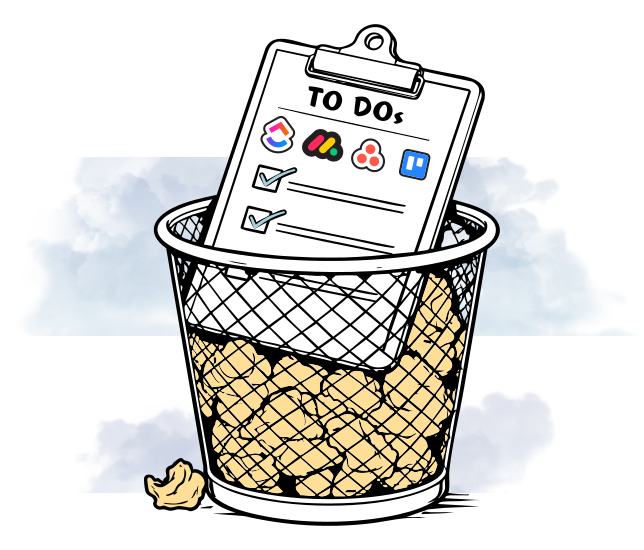
dental practice task management

They’re not broken.

They're misapplied.


Task management tools do exactly what they’re supposed to do:

  • organize work
  • assign responsibility
  • track completion

And in the right environment, they work well.


But dentistry isn’t that environment.

Because "completion" is does not guarantee execution.
It’s confirmation that something was marked done.

The Assumption Built Into Every Task Tool

Every task system—no matter how advanced—relies on a simple premise:
work can be planned, assigned, and followed through in a stable sequence

That’s true for:

  • projects
  • campaigns
  • product development


It’s not true inside a dental practice.

Because Your Day Doesn’t Follow a Plan

It unfolds.


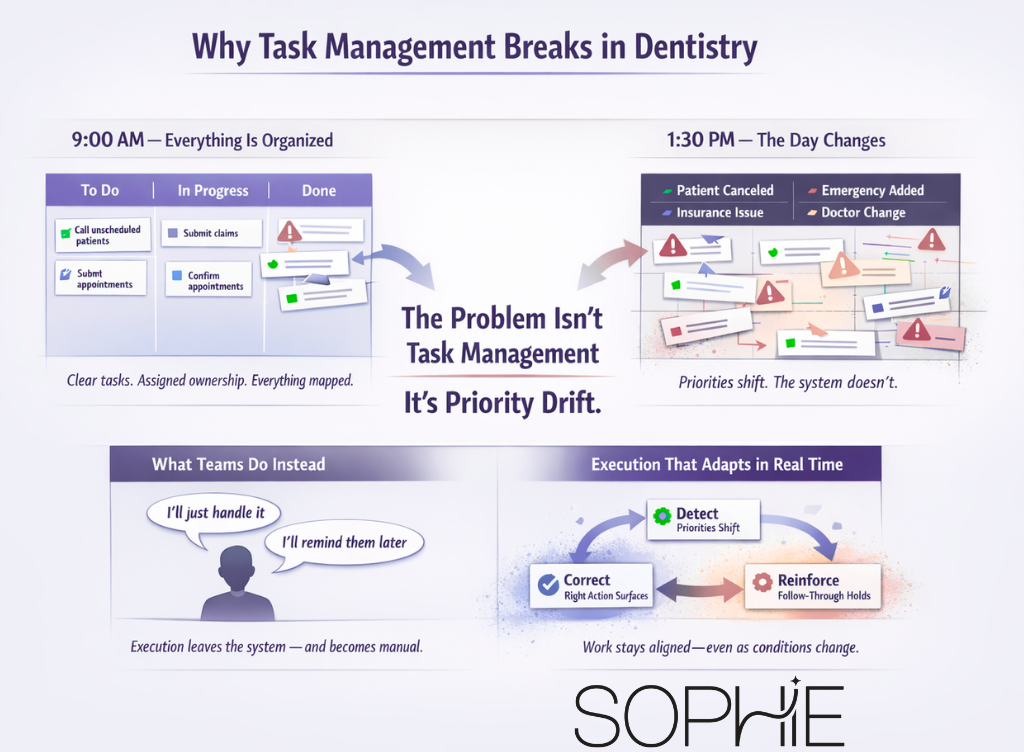
A patient cancels.

Another needs urgent care.

Insurance information changes mid-process.

A treatment plan shifts after a conversation.


What mattered an hour ago… doesn’t anymore.


And something that wasn’t even visible becomes urgent.

The Subtle Moment Everything Disconnects

This is where most teams don’t notice the break.


The task list still exists.

The board is still there.

Assignments are still technically “correct.”


But in reality:

  • priorities have shifted
  • context has changed
  • the next best action is different


And the system hasn’t adjusted.

Most task systems assume stability:

clear priorities, fixed timelines, predictable ownership.


Dentistry has none of those.

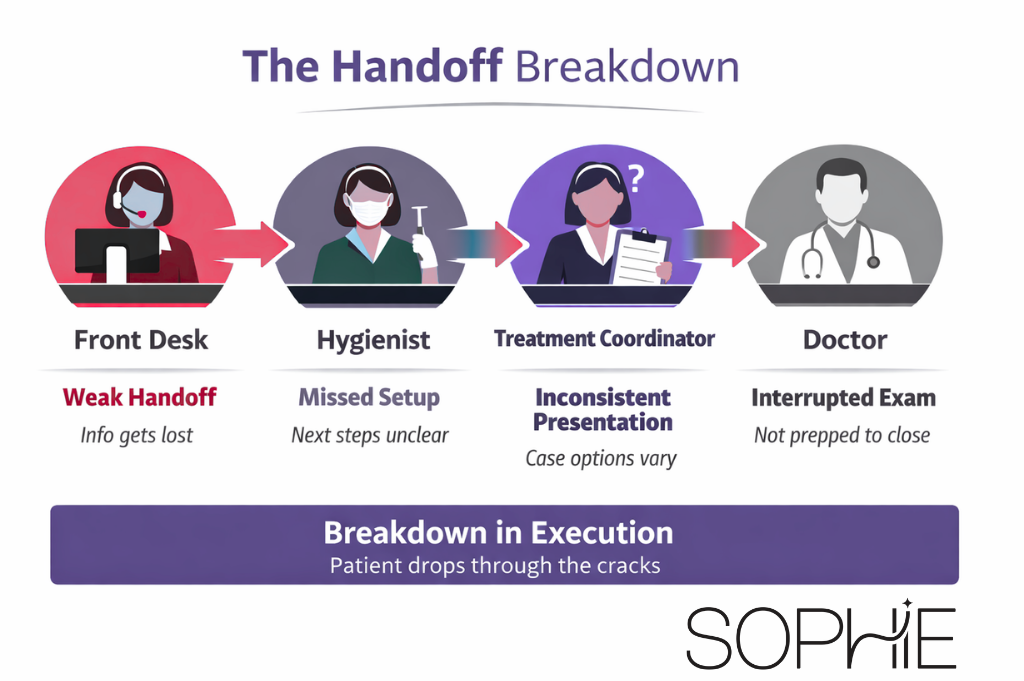
So the Team Adjusts Instead

Quietly.


  • A coordinator handles something without updating the tool
  • A follow-up gets done “off-system”
  • A decision gets made in conversation, not in the workflow


No one announces it.


But from that moment on:

the system is no longer driving execution

people are

Most systems for accountability are built on the same assumption:

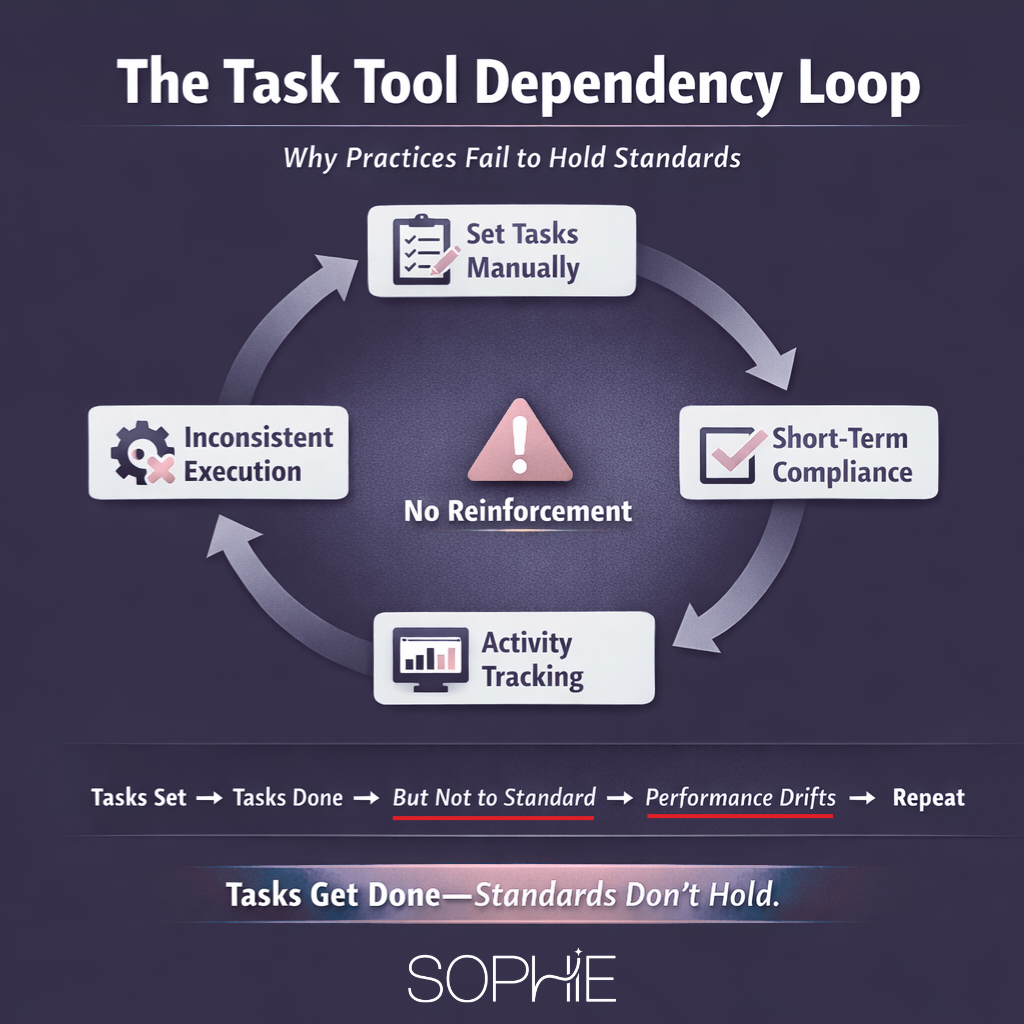
If you assign it, track it, and follow up— it will get done.


And that works…

As long as someone is actively managing it.


But dentistry doesn’t operate in controlled conditions.

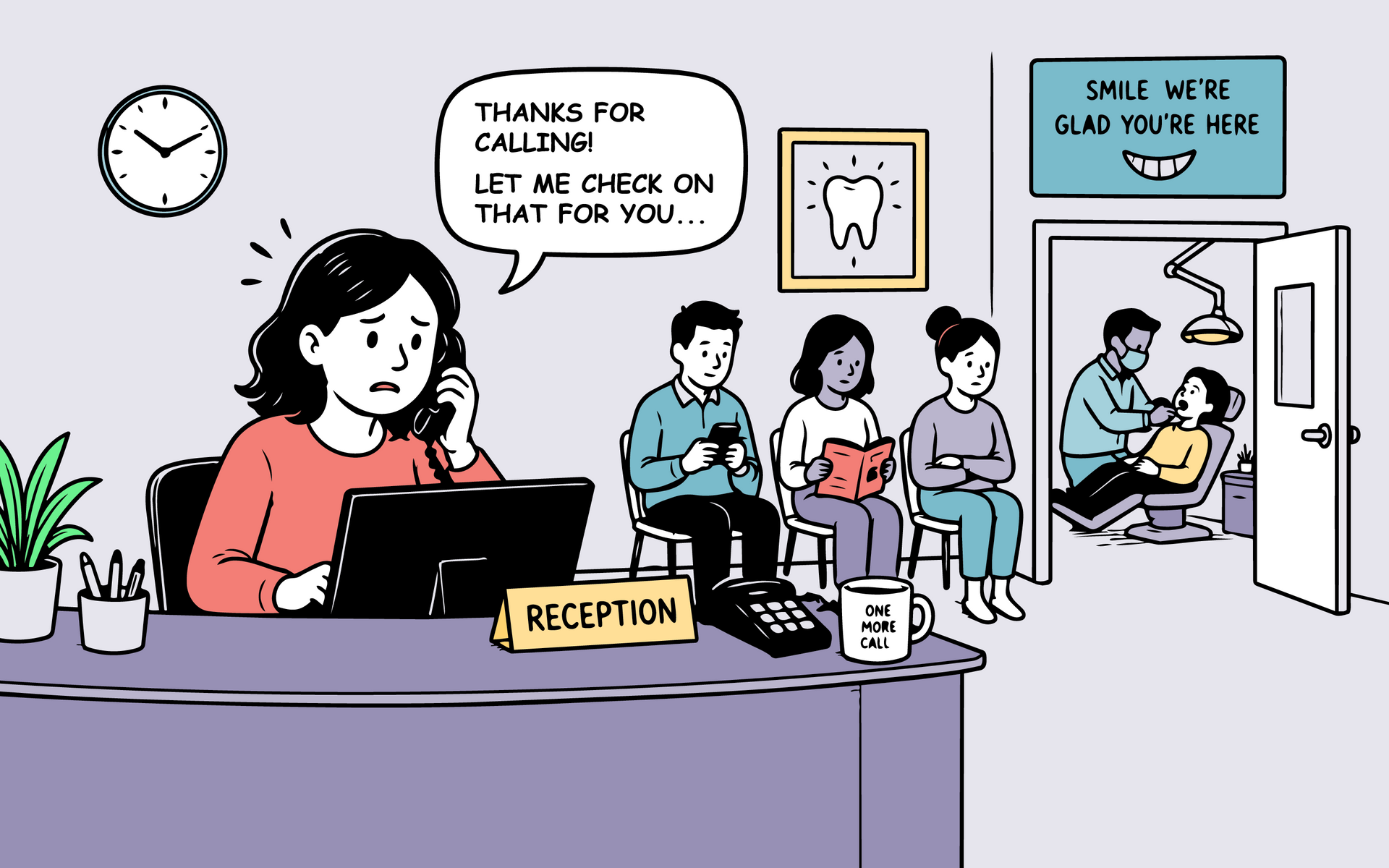
It operates in constant interruption.

The Real Failure Isn’t Task Tracking

It’s Priority Drift.


In dentistry, the biggest risk isn’t forgetting what to do.


It’s this:

  • what matters changes—and nothing updates with it

So:

  • important work gets delayed
  • follow-through becomes inconsistent
  • outcomes depend on who notices what

Not what’s been assigned.

task management dentistry

Why More Structure Makes It Worse

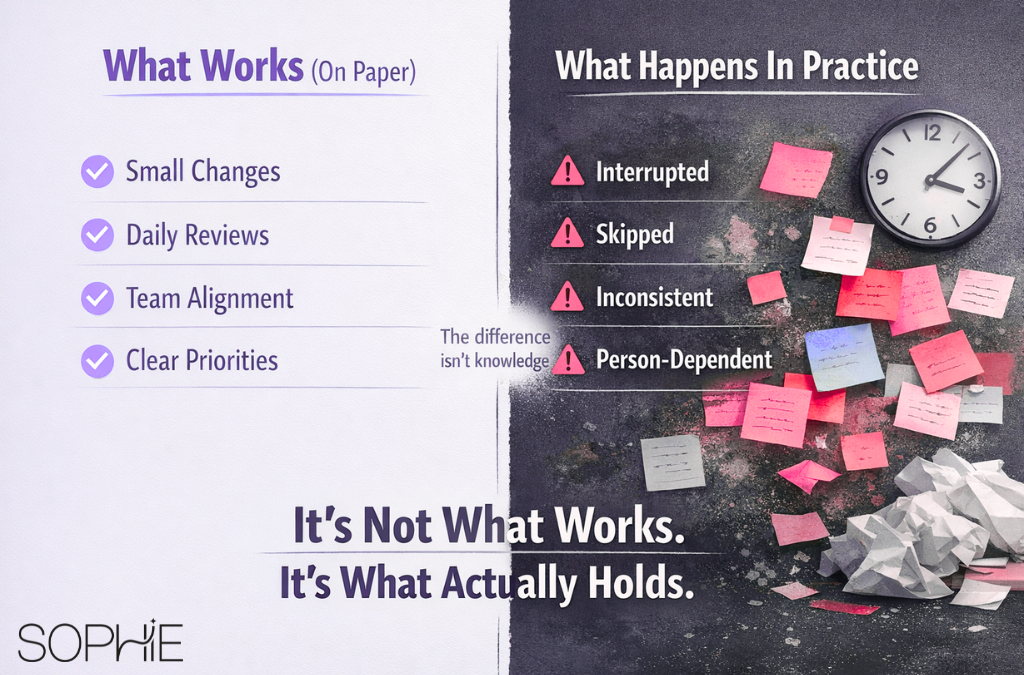
When this starts happening, most teams respond by tightening control:

  • more tasks
  • more detail
  • more checklists
  • more oversight


It feels like progress.


But it creates:

  • more to maintain
  • more to manage
  • more dependence on someone keeping it aligned


Not more execution.

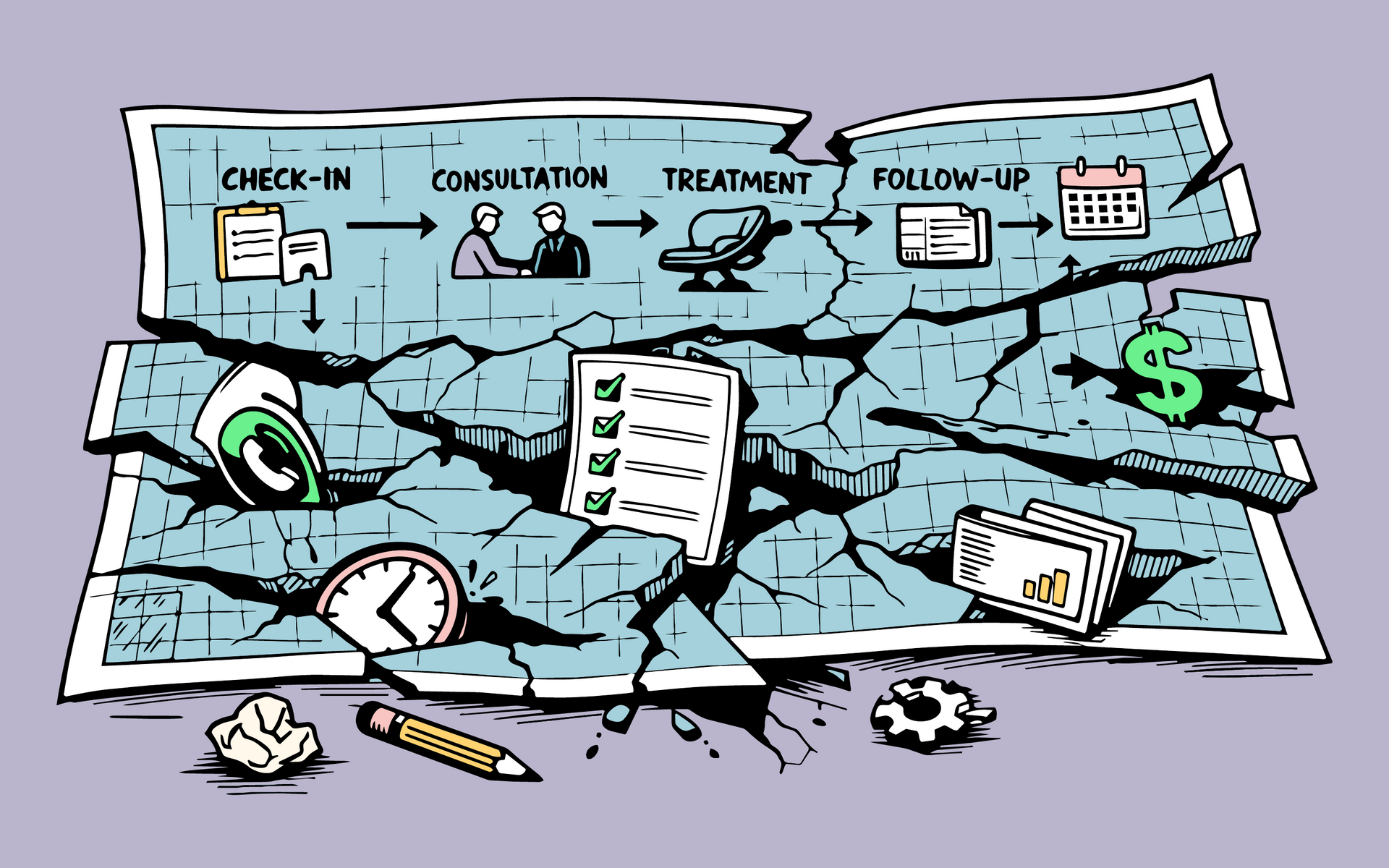
A task gets checked off—but the patient was never actually contacted.

Why It Always Ends Up Back on You

Eventually, someone has to:

  • decide what matters now
  • re-prioritize in real time
  • catch what’s slipping


In most practices, that becomes:

  • the owner
  • the office manager
  • the most experienced coordinator


Not by design. By necessity.

task tool dependency loop

This Is Why “Organized” Practices Still Feel Unstable

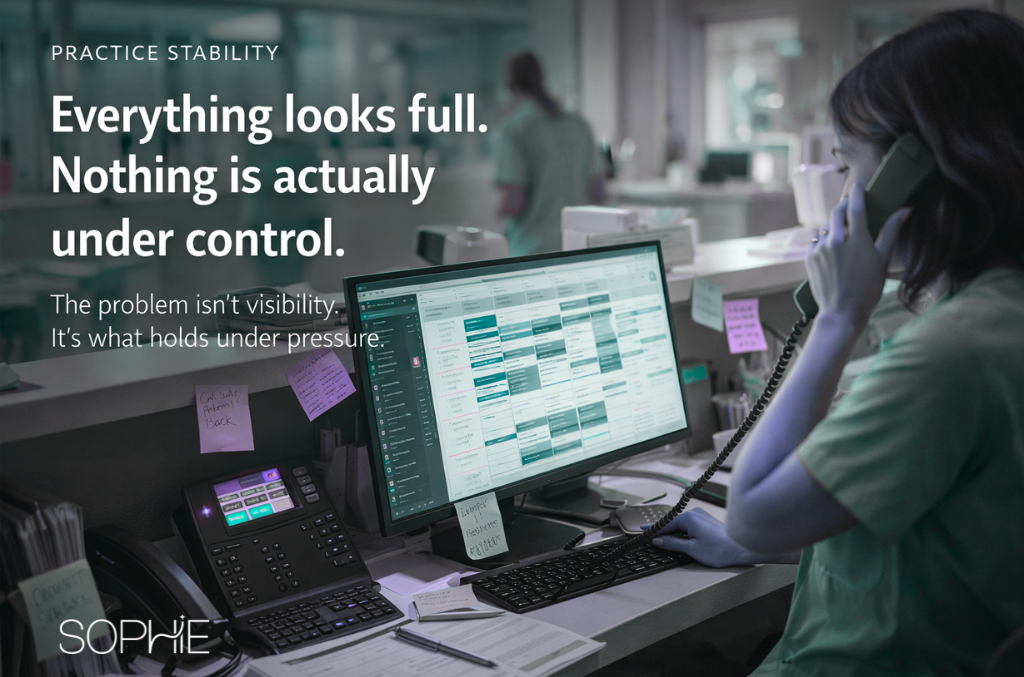
Everything looks structured.


Tasks are assigned.

Processes exist.

Systems are in place.


But the moment conditions shift:

  • alignment breaks
  • execution fragments
  • performance becomes inconsistent


Because the system can’t adapt fast enough to reality.

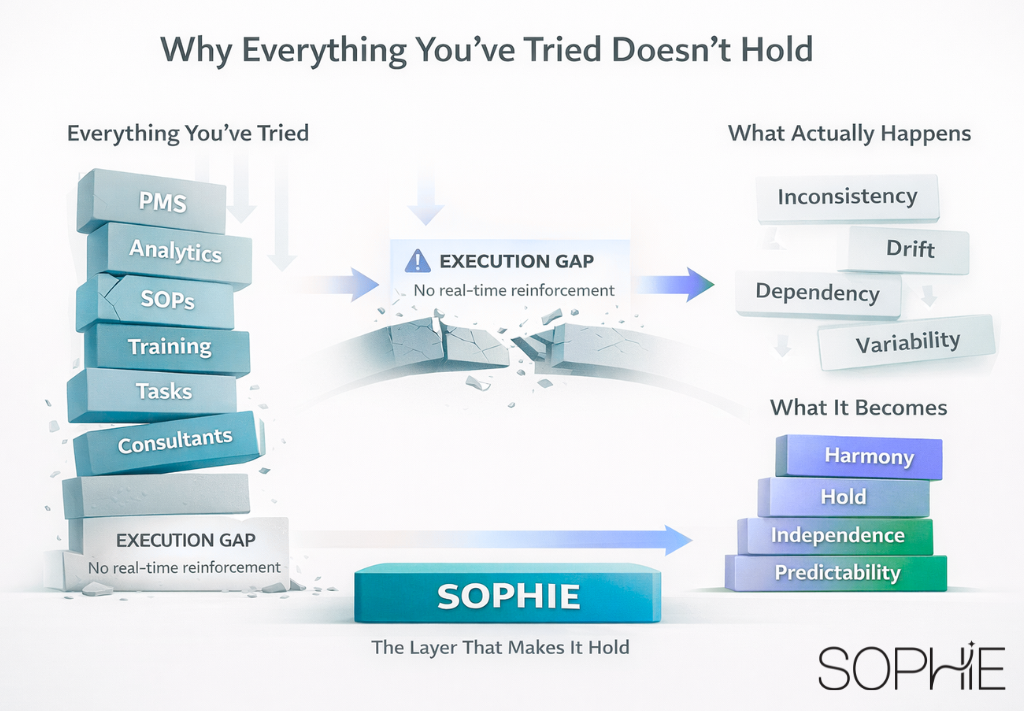
The Pattern Across Every Tool

This isn’t just a task management problem.


It’s the same pattern across:

  • software
  • SOPs
  • PMS systems
  • reporting tools


Each one helps you see, organize, or define the work. None of them ensure it moves.

What Actually Works in a Real Practice Environment

Not a better task system.


A system that:

  • adapts as priorities change
  • surfaces what matters in real time
  • ensures follow-through without manual intervention

Because in dentistry:

execution doesn’t fail from lack of structure...

 it fails from lack of alignment under changing conditions

Where SOPHIE Changes the Model

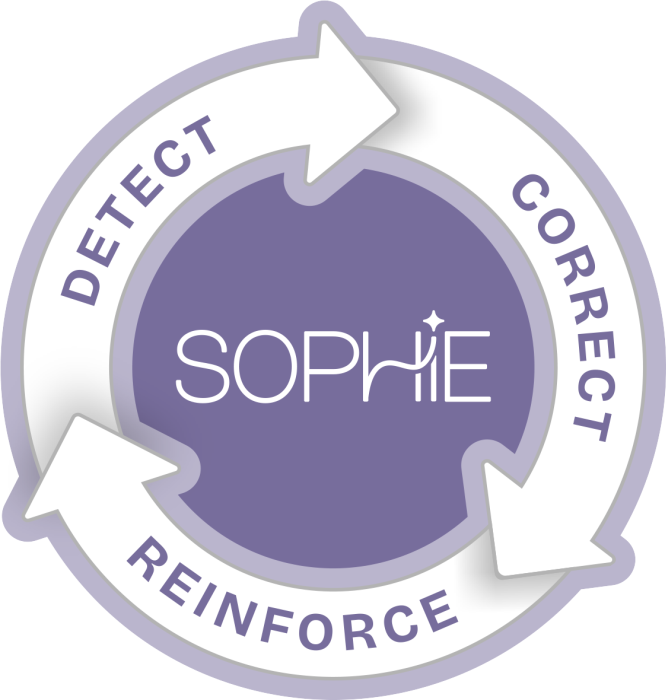
Detect

When priorities shift and execution starts to drift

Correct

What needs to happen now (based on current conditions)

Reinforce

So standards hold, regardless of who’s working

If Your System Needs Constant Management, It’s Not a System It’s a dependency.

And dependency is what makes performance fragile.

See How SOPHIE Keeps Execution Aligned...

Even When the Day Changes

SOPHIE ensures work doesn’t just get assigned.


It gets completed.


Consistently.

Across roles.

Without constant oversight.


👉 See how SOPHIE stabilizes your practice

dental practice sofware
March 24, 2026
Most dental practice software tracks activity—but doesn’t ensure execution. Learn why case acceptance, unscheduled treatment, and insurance aging persist—and what actually fixes it.
dental practice operational improvements
March 24, 2026
If your dental practice improves—but never stays consistent—this explains why. Discover the hidden reason execution keeps breaking (and what actually fixes it).

dental consultant
March 23, 2026
Dental consultants drive improvement—but why doesn’t it last? Discover the real reason change fades and what’s missing inside dental practice operations.
dental training fails
March 23, 2026
You trained your team. So why isn’t the work happening consistently? The real reason training fails in dental practices—and what actually fixes it.
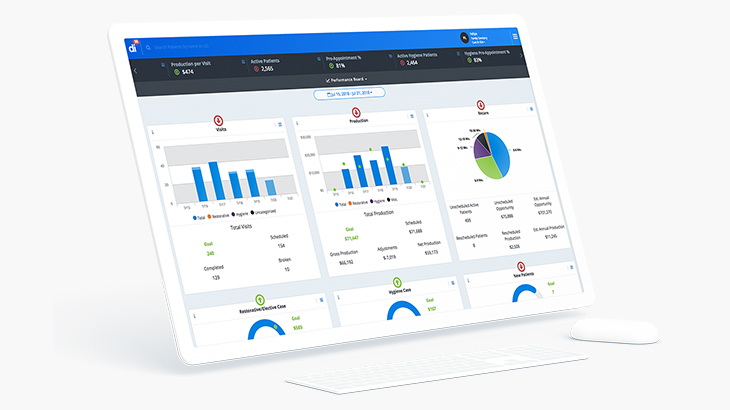
dental analytics practice intelligence
March 20, 2026
Your reports show exactly what’s wrong—but nothing changes. Here’s why dental analytics tools fail to improve performance.
practice management software
March 20, 2026
Your PMS shows everything—but doesn’t control anything. Here’s why operational problems persist and what’s actually missing in dental practices.
dental SOPs
March 20, 2026
SOPs tell your team what to do—but don’t ensure it happens. Here’s why dental SOPs fail and what actually drives consistent execution.
dental practice performance
March 20, 2026
Most dental software tracks activity—but doesn’t ensure execution. Here’s why performance doesn’t improve and what’s actually missing.
dental operations system
March 20, 2026
Many dental practices appear stable—until one person leaves. Learn why person-dependent systems create hidden risk and how to build consistent execution across your team.
dental staffing opertional standards
March 20, 2026
Flexible staffing can solve coverage problems, but many dental practices still break down after team changes. Learn why temp and new staff expose operational instability—and what fixes it.
Show More